 Genius Asian
 DIY Fence part 2: Two Privacy Fence Gates and 3 Different Gate Latches
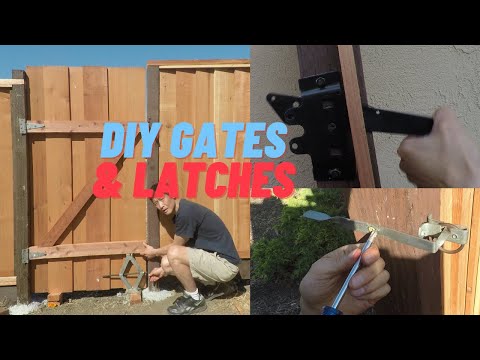
DIY Fence Part 2: Privacy Fence Gates and Gate Latches
Gates see more wear than any other part of a fence, so they often need repair or replacement first. In this video, Dr. David Zhang shows step by step how to build a privacy fence gate using board-on-board construction and demonstrates three different types of gate latches.
Building the Gate
A simple butt-joint gate will develop visible gaps as the boards shrink over time. Board-on-board or louvered designs maintain privacy even as wood naturally contracts. Dr. Zhang demonstrates the complete construction process, including the frame, the board layout using the formula from Part 1, and proper hinge installation.
Working Solo
Installing a heavy gate alone is challenging because maintaining precise gap tolerances is difficult without a second pair of hands. Dr. Zhang shows techniques for supporting the gate during installation to ensure proper alignment and consistent gaps.
Three Types of Gate Latches
The video demonstrates a ring latch and two different lever latches, showing how each operates and how to install them. Since it can be hard to understand how latches work from product photos alone, the hands-on demonstration clarifies the mechanism and helps you choose the right latch for your situation.
For the overlap formula used in this project, see Part 1 of the fence series. For more home repair, check out how to do bathtub caulking and rearview mirror repair.
Why Board-on-Board Construction
If you place boards next to each other to make a gate, as the boards naturally dry and shrink, you will gradually see gaps emerging between them. To build a true privacy fence gate, you lay boards in an overlapping fashion. The professional term is board-on-board or louver.
Six-Step Gate Construction Process
Step one: cut two 2x4 pieces of lumber with length W, which is the gate width.
Step two: fasten three boards to the 2x4 to form layer one. To keep the gate from being too heavy, the minimum six boards needed are sufficient. With board width B and the space between two boards being S, the formula for the overlap is given by the equation derived at the end of the video.
Step three: fasten the layer-two boards. When fastening the last board, since there is no first-layer board underneath it, use a small scrap board so that this board can be fastened normally.
Step four: flip the gate and cut a 2x4 to fit diagonally, then fasten it to the other 2x4s.
Step five: fasten boards to the diagonal 2x4, using a tape measure to aid positioning of each fastener.
Step six: fasten hinges to the gate. If the gate opens inward, you can fasten the hinge plate on top of the 2x4s, making sure the gate can open 180 degrees — that is, the two plates swing from a closed position of 180 degrees to 360 degrees. If the gate opens outward, place the hinge plate between the boards and the 2x4s — the two plates then swing from a closed position of 90 degrees to 270 degrees.
Installing the Gate Solo
Before fastening the hinge plates, make sure the gate is level. Place a couple of wood scraps and a car jack under the 2x4 to adjust the vertical position of the gate, and use a shim on the lock side to wedge it horizontally so the hinge side has the smallest gap possible. After fastening the hinge plates, remove the car jack and the shim and the gate is hung.
A gate with a total of seven boards — an odd number — is built similarly. Note that this gate uses nails where the previous gate used deck screws. In the future there may be a follow-up comparing whether screws or nails hold up better, since the two gates were built at the same time and experience the same weather conditions. If the gate turns out too high, you can trim it down.
Three Gate Latches Demonstrated
Latch one (ring/lever latch): You close the door from the front and it latches. From the back you can see how it latches when it closes. Mount the housing first, then cover the gate-to-post gap with a strip. The strip is prepared with a cut so the opening lever can come through.
Latch two (second lever latch): When you close the gate, this is how it latches. Look at the side view to see how the lever opens it from the front. A strip is made the same way to cover the gap between the gate and the post, again with a cut for the opening lever.
Latch three (simple ring latch): It is easy to install. You may use a string to open it from the front. This latch suits a lighter gate — one that does not have full-length boards — and does not need heavy hardware. This could be a kids’ summer project, by the way.
Deriving the Board-Overlap Formula
Many people simply estimate the amount of overlap and the number of boards. For a gate with seven boards, you lay four boards in one layer with symmetrical spacing, then lay three boards on top with symmetrical spacing. The first problem is that it is easy to estimate roughly the overlap with an odd number of boards, but with an even number it is not as easy because the layout is not symmetrical. The second problem is that estimating the overlap requires placing all boards first and adjusting each overlap individually. Knowing the exact overlap beforehand lets you nail one board at a time and saves time.
Assume the gate width is W, the board width is B, and the overlap amount is X. The total number of boards is N equal to 2M for an even number, because both layers have the same number of boards, and 2M plus 1 for an odd number. When you have an odd number (2M+1), the first layer has M+1 boards and the second layer has M boards. The spacing between each board in the first layer is B minus 2X, and width W satisfies the resulting equation. Rearranging gives the formula for X. For an even number (2M), both layers have M boards, the spacing is still B minus 2X, and rearranging that equation gives the even-board formula. Once you know the exact overlap amount, you can lay and nail one board at a time.