 Genius Asian
 How To Make A Free and Accurate Kitchen Scale
How To Make A Free and Accurate Kitchen Scale
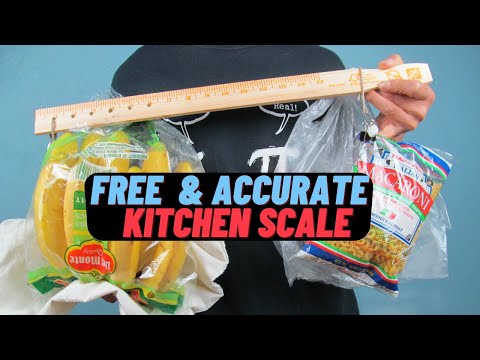
Why buy a kitchen scale when you can build one for free using materials you already have? In this video, Dr. David Zhang demonstrates how to construct an accurate, durable, and easy-to-use kitchen scale from commonly available household items. The build takes only a few minutes, and the result is surprisingly precise for cooking and baking purposes.
The Balance Scale Design
The design is a classic balance scale, the same principle that has been used for thousands of years. A paint stick or similar rigid bar serves as the beam, balanced on a fulcrum point. Known reference weights are placed on one side, and the item you want to weigh goes on the other. When the beam is level, both sides have equal weight.
The beauty of this design is its simplicity. The paint stick can double as a ruler for other projects, and all the components can be disassembled and used for their original purposes when you are done weighing. There is no dedicated storage space required.
Reference Weights You Already Have
The key to an accurate balance scale is having reliable reference weights. Dr. Zhang points out that many common household items have known, standardized weights. US coins, for example, have precise weights: a nickel weighs exactly 5 grams, a penny weighs 2.5 grams (post-1982), and a quarter weighs 5.67 grams. By combining coins, you can create reference weights for a wide range of measurements.
Other reliable reference weights include sealed packages of food with printed net weights, standard AA batteries (approximately 23 grams each), and commercially packaged items like sugar packets or butter sticks.
Improving Accuracy
Dr. Zhang provides several guidelines for optimizing accuracy. The fulcrum point should be as sharp as possible to minimize friction. The beam should be perfectly straight, and the hanging points for each pan should be equidistant from the fulcrum. Calibrate the scale first by ensuring it balances with nothing on either side, adjusting the fulcrum position if needed.
The Rubber Band Scale
For situations where the balance scale is not practical, Dr. Zhang also demonstrates a simpler alternative: a rubber band scale. By hanging a rubber band from a fixed point and attaching a small platform, the stretch of the rubber band indicates the weight. While less precise than the balance scale, it is extremely easy to make and can be hidden inside a shopping bag for discreet comparative shopping.
The rubber band scale does require recalibration if the band is stretched beyond its normal range, so it is best for comparing relative weights rather than measuring absolute values.
Educational Value
Beyond the practical kitchen applications, building a scale is an excellent STEM project for kids. It teaches principles of physics including balance, fulcrum mechanics, and measurement. The hands-on nature of the project nurtures creativity and future-proofs skills that apply to engineering, science, and problem-solving.
For more inventive DIY projects, check out our guide on how to peel garlic easily without special tools and our article on rearview mirror repair. Each demonstrates how everyday materials can solve practical problems without spending money on specialized products.
This project embodies the GeniusAsian approach: use what you have, spend nothing, and get results that rival commercial products. Whether you need to weigh flour for a recipe or teach your children about physics, this free kitchen scale delivers.