 Genius Asian
 Burn Your Business Plan: Steve Hoffman's 16 Startup Lessons at SF Tech Week 2026
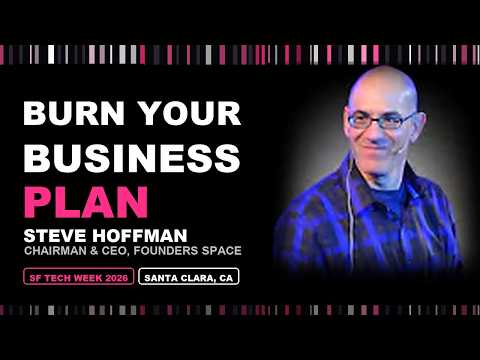
Burn Your Business Plan: Steve Hoffman’s 16 Startup Lessons at SF Tech Week 2026
Steve Hoffman — “Captain Hoff,” Chairman and CEO of Founders Space — gave the guest talk at GCSx SF 2026, an official SF Tech Week event hosted by the American Ecosystem Institute in Santa Clara, California on October 10, 2026. We streamed it live.
What follows is the full substance of his talk: sixteen lessons, most of them contrarian, several of them the opposite of what founders are usually told. He opens by telling the room to throw away their best ideas and closes by telling them their biggest risk is thinking too small.
Key Takeaways
- Don’t start with an idea — start with a direction. An idea boxes you in before you know anything. A direction keeps a dozen ideas in play.
- Demand cannot be created, only found. Your job is to drill wells until one gushes, not to convince the world it needs what you built.
- “Interesting” from a customer means you’re dead. The only signal that counts is “can I have it right now?”
- Build a platform, not a product. Products please customers. Platforms make every new participant create value for everyone already there.
- Kill your babies — but never kill experimentation. The idea you’d dismiss as trivial is the one that became YouTube, Flickr, and Slack.
- Talent beats everything, but communication beats talent. Google found its all-star teams did not win; its honest, high-trust teams did.
Part 1: Finding Something Worth Building
1. Don’t start with an idea
Most founders search until they land on what they think is the perfect idea, then fall in love with it. Hoffman’s advice: take your favorite ideas and throw them away.
“If you start with an idea, you are already boxing yourself in.”
Start with a direction instead — an area you want to explore, an outcome you want to reach. “I’m interested in how to make the fishing industry more sustainable” is a direction. From there you hold a dozen ideas loosely and test them against the real world, and you stay open to what people in that industry actually tell you.
His evidence is that almost nobody’s first idea was the winner. Google began as an academic experiment to help professors find research papers. YouTube began as a video dating site. Yelp’s reviews were a side feature, not the core product. Lock onto the opening idea and you never reach the one that works.
2. Burn your business plan
Don’t spend weeks on a business plan for a business you don’t yet understand. And don’t talk to investors early — Hoffman calls it a waste of cycles before product-market fit.
The sharper warning is about what early money does to your judgment. Founders treat a check as proof the business is real. But plenty of investors, he says, can be convinced by anyone with the right buzzwords and don’t know whether a market exists. Take that money as confirmation and you get locked into running hard in the wrong direction.
“Most entrepreneurs don’t fail because they don’t move fast enough or don’t have a great team. They fail because they are running the wrong way.”
3. Get dirty
Don’t sit in the co-working space formulating plans. Get the product into real hands at an embarrassingly early stage and watch what happens.
For enterprise customers, go in without a fixed pitch. If you arrive with a bundle of possible ideas instead of one decided answer, the conversation changes from selling to learning: what are your most critical problems, and how can I help?
Then listen to the exact words that come back. “That’s really interesting” means you’re dead. “Come back when you’ve made some progress” means you’re dead. The only reaction worth anything:
“I’ve got to have it. Can you give it to me right now? How do I sign up?“
4. You can’t create demand
This is the heart of the talk. Hoffman has built products where every detail was perfected — the technology, the interface, the whole customer experience — and they still went nowhere, because the underlying demand wasn’t there.
His metaphor is the oil wildcatter. Your job is to drill as many wells as possible. A trickle is nothing. You’re looking for the gusher: a hidden pocket of demand nobody else has tapped. Find the demand first, then build the product to meet it. The reverse never works.
The good news is that demand is dynamic, not static. Every new technology and every shift in the world creates fresh pockets of it.
He answers the obvious objection head-on. Didn’t ChatGPT create demand that never existed? No — the demand was already there. People already needed to write articles, make images, and write code. ChatGPT just made those things dramatically easier. Same with the iPhone: early smartphones like the Treo and Palm Pilot were already selling, and Jobs met that existing demand at the moment the technology could finally satisfy it.
Part 2: Building Something That Wins
5. Good versus great
If you build a good product, competitors will catch up. The App Store is littered with good products, and they die.
Great products dominate because of human nature: limited attention spans mean people gravitate to the best option and talk about it. That creates momentum — users tell friends, media covers it, investors pile on — and the great product accelerates away from the merely good ones. Hoffman’s rule: once you’ve found a big pocket of demand, you need a team that can execute at “great.” Don’t settle for good.
6. Don’t fall in love (with your product)
Love is blind. Hoffman says he can tell instantly which founders are in love with their product, because they won’t absorb a single hard question about it.
Your job as an innovator is to collect negative feedback — it’s the only information that lets you act. So fall in love with your customer instead. It doesn’t matter how much you love your product; it matters how much they do.
7. Build a platform, not a product
A product pleases a customer and the relationship is vertical. On a platform, participants also engage horizontally with an ecosystem, and every new customer, partner, and developer creates value for everyone already there.
That dynamic compounds, and it builds a wall around the business, because competitors can’t easily recreate the momentum of many parties generating value for each other.
Amazon is his example. Bezos could have stayed a store. Instead he let third-party merchants sell on Amazon’s own platform — accepting lower margins on those transactions and competing directly with his own merchants — because Amazon owned the platform, the customers, and a fee on every sale. That decision is the distance between “an online bookstore” and “sells everything in the world.”
Not every product can become a platform. Hoffman’s advice is to imagine at the earliest stage what platform your product could become, and if it can’t become a viable one, move on.
8. Value over money
The best founders don’t ask how much money they can extract from a customer. They ask how to create more value for them. Customers can feel the difference, and they hate the first kind of business.
Amazon again, through three decisions that all cost money up front:
| Decision | What every competitor did | What Amazon did |
|---|---|---|
| Returns | Made them hard — returns cost money | Made them easy, and ate the cost |
| Shipping | Charged for it | Free shipping, funded by Prime subscriptions |
| Speed | Standard delivery | Two-day, then overnight |
Each one traded margin for customer value, and compounded into the largest e-commerce business in the world. Hoffman’s practical version: keep a running dialogue with your customers. Ask what they don’t like, what they love, what they wish it did. They won’t tell you which feature to build — but they will tell you the outcome they want, and you work backwards from there.
Part 3: Knowing What to Kill
9. Kill your babies
Try a lot of things, then be ruthless. Hoffman inverts the standard founder mythology about never giving up:
“Try something, gather as much data as possible, and then figure out every reason possible to kill it. If this baby is indestructible — if it cannot be killed — that’s probably a very good business.”
10. The surgical instrument: find out who actually pays
A startup built a surgical instrument that cut error rates substantially. Surgeons loved it. Patients would have wanted it. The data was good.
Hoffman asked one question: who writes the check? Hospitals do. And the new instrument didn’t fit hospitals’ existing sterilization machines, so hospitals wouldn’t buy it. Large hospitals wouldn’t change their process; small clinics couldn’t make exceptions.
His verdict after two years of their development work: redesign it to fit the sterilization equipment, or kill it and start over.
The general rule: identify who actually pays, not who loves the product. With a children’s toy, the buyer is the parent. The children can beg all they like — if the parent thinks it’s unsafe, it never sells.
11. Interval Research: kill ideas, never kill experimentation
Paul Allen poured a personal fortune into Interval Research, hiring the best engineers, inventors, artists, and designers in Silicon Valley with one rule: every product had to be an obvious future hit, or it got killed immediately.
Almost nothing succeeded.
The flaw is that at the earliest stage you often cannot see which small thing becomes big. Products have to be allowed to take shape, and the most trivial-looking feature is frequently the one that matters:
- YouTube’s founders were building a video dating site. It wasn’t working — people hate dating on camera. Frustrated, they used their own tech to share a house-party video with friends via a link, and the friends were thrilled. That “tiny innovation” was the company.
- Flickr came from a failed game whose users only cared about one side feature: sharing photos. It sold to Yahoo.
- Slack came from the same founder’s next failed game. When it flopped, he looked at what his own engineers were actually doing — they’d rigged an internal messaging tool for themselves — and spun that out.
Interval Research would have killed all three as too small. So: kill ideas once the experiments genuinely fail, but never kill the experimenting.
12. The smart refrigerator: do your own market research
A corporate innovation team told Hoffman they’d been given a budget for market research that would take at least three months.
“You’re not thinking like an entrepreneur. You can start the market research today, right now, and it will cost you nothing.”
He sent them into stores that already sold early smart refrigerators — to talk to shoppers about what features they actually wanted, and crucially to talk to the salespeople: what sells, what nobody cares about, and why people return them. He gave them a week, not three months.
Part 4: Team and Management
13. Feed your lions, starve your turkeys
Some employees are lions — self-motivated, pushing, always trying things. Others drag their feet and wait to be told what to do.
Put your time, money, and attention on the lions. In a big company you may be stuck with the rest, so ignore them; in a startup you have no room for them at all. Then go lion hunting for more.
His allocation is blunt: before you settle on an idea, before you build, before you raise — spend 85% of your effort on finding the people you’ll work with, with talents complementary to your own.
14. What Google learned about teams
Google compared thousands of its teams to see whether the ones packed with superstars outperformed the rest. To the company’s surprise, they didn’t. (The study is widely known as Project Aristotle.)
The teams that won were the ones with the best communication — people who trusted each other, had each other’s backs, and could say what they honestly thought when something was wrong.
So hire smart, capable people; they don’t have to be the best in the world. What you must guarantee is how the team communicates and bonds. Address passive-aggression and unspoken disagreement at the very beginning, because a team that’s genuinely in it together is what propels a company forward.
15. Ask, don’t tell
Hoffman asked the room to promise they’d try this for one week. Instead of telling your team what to do, ask: What are you working on? Why that? Why is it the most important thing right now? What result do you expect?
Two things happen. You find out what’s actually in their heads — and the thing you were about to shut down may turn out to be more valuable than your own plan. And you stop sounding like a micromanager. Turn any instruction into a question and the work becomes their idea, which means ownership and commitment instead of waiting to be told.
16. Your biggest risk is not taking a big enough risk
His closing challenge. Asked what the biggest risk to a startup is, the room answered money, AI, misunderstanding the customer. Hoffman’s answer:
“Your biggest risk is not taking a big enough risk.”
Founders pick small ideas because small feels safe and within the team’s current ability. But a small idea takes an enormous amount of work and pays off small — a slow, conservative business you labor at for years. The failure probability isn’t much different. So take the calculated big risk instead, on a bigger market.
He ends with the investor’s view: he won’t fund a small idea. A big one might return 1,000x or 10,000x; a small one, if everything goes right, doubles his money. And missing resources or team are things you can change — especially here, he told the room, because you’re in Silicon Valley.
About the Speaker and the Event
Steve Hoffman is Chairman and CEO of Founders Space, a startup accelerator and venture builder with partners across dozens of countries. He’s an angel investor and the author of three award-winning books — Make Elephants Fly, Surviving a Startup, and The Five Forces That Change Everything. Before Silicon Valley he was a TV development executive in Hollywood.
GCSx SF 2026 was an official SF Tech Week 2026 event, part of the Global Connect Show series hosted by the American Ecosystem Institute, held in Santa Clara, California on October 10, 2026 from 3–6pm for founders, developers, investors, and ecosystem leaders. (SF Tech Week events run across the Bay Area, not only in San Francisco itself.)
Sources
- Steve Hoffman’s guest talk at GCSx SF 2026, October 10, 2026 (full recording above)
- Founders Space — foundersspace.com
- GCSx SF 2026 event listing, American Ecosystem Institute
Next Steps
If you take one thing from this talk, make it the customer question. Before the next feature, go find out who actually pays — and whether anyone says “can I have it right now?”
Which lesson contradicts the advice you’ve been given most often? Tell us in the comments on the video.