 Genius Asian
 DIY face masks in 10 seconds & improve cheaper masks
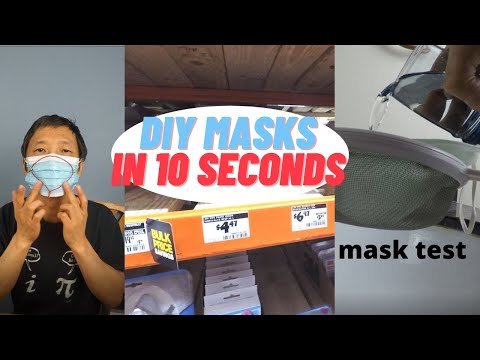
DIY face masks in 10 seconds & improve cheaper masks
Key Takeaways
- What do you do if all face masks are sold out at every single store
- After the coronavirus (Covid-19) began spreading, there were soon no more face masks at any store
- Restocking could take weeks
- I will show you how to make your own DIY mask in 10 seconds
- What if the N95 masks are not available to you but you have a surgical masks
Why This Matters
What do you do if all face masks are sold out at every single store
- After the coronavirus (Covid-19) began spreading, there were soon no more face masks at any store
- Restocking could take weeks
- I will show you how to make your own DIY mask in 10 seconds
- What if the N95 masks are not available to you but you have a surgical masks
Making a Mask From Nothing: The Napkin Method
Welcome to the Genius Asian family. Today I’m going to show you how to DIY face masks when masks are sold out in stores, and how to make a cheap mask more secure.
These are napkins and these are rubber bands. Unfold the napkin, then lay the first rubber band loop along the bottom edge as the bottom strap, and the second rubber band loop along the top edge as the top strap. Pull the bottom strap over your head and place it on the back of your neck, then pull the top strap over your head. Done in 10 seconds.
What Masks Actually Do — and Don’t Do
An N95 mask can filter at least 95% of airborne particles, if you wear it correctly. A surgical mask — or the DIY napkin mask we just showed — does not effectively filter small particles from the air, and does not prevent leakage around the edge when the user inhales. Since surgical masks are not designed to pass a fit test, we should at least try to make the mask fit as well as possible if we don’t have access to an N95.
The N95 rating means the mask blocks about 95% of particles that are 0.3 microns in size or larger. For reference, a human hair is 50 microns.
Improving Fit on Cheap Masks
If you only have cheap masks, the biggest problem is that they may not fit well, and there will be leakage around the edge. Even though the ear loops are made of elastic material, they usually are not adjustable on cheaper masks. I use a couple of rubber bands to make them more secure.
Most cheap face masks have a stiff metal strip along the top edge to address gaps around the nose — mold that strip to the bridge of your nose to eliminate gaps. Usually the colored side of the mask faces outward, with the metallic strip at the top.
Reinforcing With Wire for a Better Seal
If you don’t have a nose strip, or you’re worried it may not stay secure, there are other ways to reinforce. One method is to use wire. Make a loop first, then bend the wire to fit your face. Attach rubber bands to the wire. You can place the wire on the outside of your mask to eliminate gaps along the nose and cheeks. You can additionally wrap it with a napkin so that the wire is not exposed and is less visible.
This gives you a more secure double layer of protection. Although it is not as good as an N95 mask, it is likely better than wearing a single, loose-fitting mask.
If you can also wear goggles, you are protected a few percent more.
Simple Tests to Compare Mask Effectiveness
There are a couple of simple tests you can do to compare the effectiveness of different materials.
The first is a light test. Hold the material up to a light source — surgical masks block a meaningful amount of light. Napkins also block some light. A paper towel is more porous than a napkin. A cotton mask is also fairly porous.
The second is a water barrier test. Pour water onto the material. Surgical masks do not leak any water. Napkins hold water, at least for a short time. Paper towels leak water right away. Cotton masks also leak.
We propose these minimal testing methods not because they are rigorous, but because it is important to understand the actual effectiveness of what you are wearing.
Why Realistic Expectations Matter
Having an unrealistic sense of security — wearing a mask that doesn’t fit well, or being unaware of how effective it actually is — is also dangerous, because you might overexpose yourself to whatever it is you are trying to avoid.
Share this with people you know who need it. Leave your own genius tips in the comments below.