 Genius Asian
 How Effective Is Your DIY Face Mask? Easy Home Test
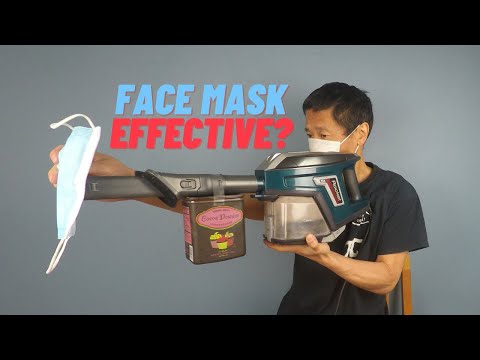
How Effective Is Your DIY Face Mask? Easy Home Test
Is your face mask actually effective? How do you test the quality of your mask, especially a DIY mask? Avoiding this question is unsafe because it gives you a false sense of security. In this video, Dr. David Zhang shows how to test mask filtration effectiveness at home without special laboratory equipment.
Multiple Testing Strategies
Dr. Zhang provides multiple testing strategies depending on what materials and tools you have available. The tests evaluate how well different materials filter particles of various sizes. Since different materials have different strengths, testing allows you to make informed decisions about which household materials make the best mask filters.
What Materials Work Best
After the earlier viral video on DIY face masks generated thousands of questions about which materials to use, Dr. Zhang conducted systematic testing. The video demonstrates additional filter materials and ranks them by effectiveness, helping viewers choose the best option from what they have available.
Beyond Masks
The testing methodology can also be applied to evaluate DIY vacuum bags, air purifier filters, and other filtration applications. The principle of measuring before-and-after particle counts or visual opacity applies to any filtration testing scenario.
The Bigger Picture
Besides face mask concerns, the video addresses the toilet paper shortage with a link to DIY portable bidet solutions, face shield construction for eye protection, and effective handwashing techniques. The priority order for protection is: wash hands first, then protect mouth and nose, then clean surfaces, then protect eyes.
For more household solutions, check out our guides on how to peel garlic easily without special tools and rearview mirror repair.
Testing your mask’s effectiveness is not optional — it is essential for your safety. This video gives you the tools to verify rather than assume.
The Flour Test: A Home-Invented Baseline for Filter Comparison
This white powder is just flour. The flour test was invented as a way for you to compare different filter materials at home without special laboratory equipment.
The first material tested is a sock, using a vacuum cleaner as the pressure source. The sock is used to cover the vacuum cleaner’s attachment, and then the vacuum is applied to suck up the flour. The flour disappeared — meaning it passed right through. Imagine breathing all of that into your lungs if you were wearing a sock as a mask.
You may have seen people in China wearing orange peels as masks. No joking. Is it effective? Testing it with the flour: no flour disappears, so it does block small particles. However, it also blocks oxygen, which you need. The goal is a material that lets oxygen through but blocks small particles.
The one-layer test can eliminate orange peel immediately. But some may argue that the flour didn’t actually pass through the sock — it could have been captured inside the sock fibers. Shaking the sock shows no white powder inside, but you can still imagine flour sticking to the fibers. To settle the question, a black cloth is placed behind the sock and the vacuum is applied. In this two-layer test, you can clearly see white color appearing on the black cloth — the flour has been pulled through the sock and onto the cloth. This proves a sock is not a good filter material.
To compare two materials side by side, half the adapter opening is wrapped with sock and the other half with a paper napkin. After vacuuming, the sock half shows significantly more white color. Many hours of debate among viewers can be resolved in about three seconds.
Cornstarch for Sub-Micron Testing and the N95 Question
Flour is larger than one micron, so the flour test can only prove that a material filters particles larger than one micron. For an N95 mask — which is rated to filter 95% of particles 0.3 microns in size or larger — smaller particles are needed for testing.
Cornstarch, which ranges from 0.1 to 0.8 microns in size, is used as the next test material. Unless you want to spend more money, it is a good approximation because some cough aerosols floating in the air can be that size.
When the N95 mask is vacuumed with cornstarch, some white color does appear on the black cloth. There are three possible explanations. First, some cornstarch particles may be smaller than 0.3 microns, and naturally any material would allow that size to pass through. Second, the mask could be a counterfeit — in that case, a legitimate mask would be needed for comparison. Third, 95% of the particles are being blocked and the white color represents only the remaining 5%. This is plausible because noticeably more of the starch is stopped than passes through.
The most important benefit this test provides is relative comparison: a good material versus a questionable one. Light green colored mask one failed the cornstarch test, but blue colored mask two passes it.
A common misconception worth addressing: some argue that because coronavirus is 0.1 microns and the N95 filters down to 0.3 microns, the mask is useless. The answer is that while coronavirus particles themselves are 0.1 microns, the droplets carrying them are larger than 0.1 microns. A mask that can repel water minimizes the probability of infection. The difference between a medical N95 and an industrial N95 is that the medical version can repel water. Previously demonstrated water tests address this — when droplets land on your mask, the mask must prevent them from seeping through.
Testing Maxi Pads, Coffee Filters, and Dark Powder for Precision
Some viewers suggested diapers and maxi pads. Testing proceeds with a maxi pad. The sticky side is waterproof — like the orange peel, it blocks air entirely. The flower does not move at all from that side. The only usable orientation is soft side facing the face, with air entering from the sides rather than the front.
Tearing the pad open reveals a thin sheet covering cotton ball-like fibers. The thin sheet alone is tested: it passes the flour test but fails the cornstarch test. The center of the pad has double layers; testing the center produces a lighter white color but still fails. This is understandable because the purpose of a maxi pad is to absorb liquid, not filter particles. Additionally, maxi pads — like diapers — may contain undesirable chemicals not suitable for the lungs: chemicals intended to absorb moisture and mask odors may include bleach, tributyltin [?], dioxins, fragrances, and similar compounds.
For the coffee filter, a single layer is tested using cocoa powder. When you check the opposite side of the coffee filter after vacuuming, you can clearly see the cocoa powder on the back.
When a very small percentage of white powder appears on the display layer, it can be hard to see. Black powder on a white filter may be more visible. Dark powder lubricants with known particle sizes can replace the white powder for higher precision. Even if you don’t know the exact particle size of your chosen dark powder, you can still compare the relative effectiveness of different materials.
Calibrating the Vacuum and Understanding Test Limitations
Vacuum cleaners vary in power and in the size and shape of their adapter openings. If your test shows no particles passing through any material, your vacuum cleaner may be too weak. Adjustments include using tape to block part of the hole or changing the adapter. The smaller the opening, the higher the suction pressure. You can use your thumb to block the opening to test the sucking pressure. Running the vacuum with a timer helps standardize the test.
Because the exact particle size of cornstarch or cocoa powder cannot be precisely controlled, and because vacuum pressure cannot be calibrated to industrial test standards, this method is designed for relative measurement — comparing the relative effectiveness of different materials — rather than certifying precise filtration standards or particle size ratings.
For industrial-grade[?] reference material testing, a compressor rather than a vacuum would be used, as compressors provide much higher pressure.
The Three-Layer Test and Using Known Reference Filters
The three-layer test resolves lingering doubts. For the first example, in theory the dark cloth itself may have been cleaned by the vacuum suction, which would mean no white color appears even if the test material failed. If the flour disappears but no white color shows on the black cloth, add a better-known filter — such as a mask or a vacuum cleaner bag — behind the black cloth.
With a previously used disposable mask placed behind the black cloth, flour appears on both sides of the black cloth. This three-layer arrangement gives 100% certainty: the sock is not a good material, and the mask is a better one. The third layer captures the powder and also functions as a comparison reference layer — you can directly compare how much accumulates on the test layer versus the reference layer.
Other known reference filters suitable for the third layer include vacuum bags and HEPA filters. Depending on your goal, you can choose which combination of layers to use.
Applying the Test Beyond Face Masks
This testing methodology applies to filtration in general, not just face masks. Some DIY videos show vacuum cleaner bags made from old t-shirts. After seeing this test, you can picture how much dust passes back into the air through such a bag — and once you breathe in fine dust, your lungs have no exit route for small particles.
I have seen many crafty people making colorful and pretty DIY masks without ever testing the materials for filtration effectiveness. This invention may not win a Nobel Prize, but sharing this video could help save lives at a time when people genuinely need it.
Leave your own genius tips in the comments below.