 Genius Asian
Why Would a VC Call Jesus the Ultimate Founder? A Venture Capitalist's Case
Why Would a VC Call Jesus the Ultimate Founder? A Venture Capitalist’s Case
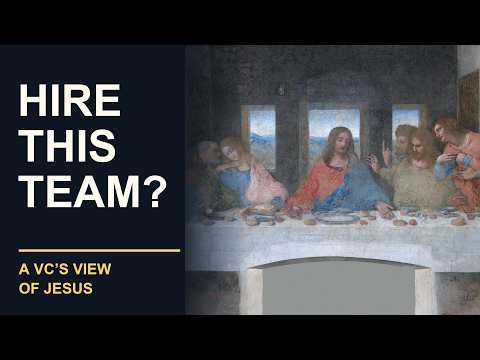
Would you hire this team? A carpenter. A fisherman. A tax collector. And a teammate who would later betray the leader. Put those four résumés in front of a modern hiring committee and you would not get to the second round.
Yet Dr. Chun Xia, Founding Partner at TSVC, argues that a venture capitalist looking at this story would see something they almost never see: a mission that outlived empires, growth with no advertising budget, and a team that kept going after the founder was gone.
This article follows the two-host debate in the video above, which adapts Dr. Xia’s essay “Jesus: The Most Perfect Entrepreneur in Human History.” The comparison is deliberately an analogy — a lens for thinking about what makes organisations durable, not a history of Christianity and not a theological argument. The interesting part is where it holds, and where it breaks.
Key Takeaways
- Most pitches solve a shallow problem. A faster ride, a cheaper meal. The deeper the pain a product addresses, the longer people stay.
- Great brands sell identity, not specifications. “Think Different,” “Don’t be evil,” a cleaner future — that’s why attacking someone’s favourite brand feels personal.
- An MVP can be an idea, not a product. A seed. A field. A lost son coming home. Small enough to remember, big enough to carry your life inside.
- One-way pitches say “buy this.” Two-way stories ask “where are you in this?” Only the second kind gets retold for free.
- Values are cheap until they cost something. A vision statement is free. Kneeling to wash someone’s feet is not.
- Product-market fit may live where the money isn’t. The deepest wound can reveal the strongest need.
- The real test starts when the founder leaves the room. If nothing guides the next decision, there was never a mission — only supervision.
Part 1: What Was the Product?
Most pitches begin with a problem, and most problems are small. A faster ride. A cheaper meal. A tidier inbox. These are real, and they build real companies.
The claim in the video is that this message reached for a different class of pain: fear, loneliness, and the feeling that your life doesn’t matter. The offer was hope, belonging and meaning.
That sounds like it belongs in a sermon rather than a pitch meeting — until you notice how many of the most valuable companies on earth describe themselves in almost exactly those terms.
Identity, not specifications
Buying a phone doesn’t fix your soul. Nobody in the video claims otherwise. But consider what the companies actually said:
- Apple: Think Different
- Tesla: cars tied to a cleaner future
- Google: Don’t be evil
- Elon Musk: humanity living on other planets
None of those is a specification. They’re identities. And identity is why brand arguments get strange so fast. When someone attacks your favourite brand, why does it sometimes feel like they’re attacking you? Are you defending a product — or the person you believe you are?
That is the mechanism the analogy is pointing at. A company that only sells features competes on features forever. A company that offers an identity gets defended by its customers.
The four foundations
The video frames the comparison on four religion-like foundations:
- A mission to end suffering — not to capture a market.
- Shared values — the thing that decides behaviour when no one is watching.
- A rock-solid community of users — people who belong, not just buy.
- The founder’s willingness to sacrifice for meaning — the costly signal that the first three are real.
Read that list as a checklist for a startup and most fail at item four, because item four is the only one you cannot write into a deck.
Part 2: The Team Nobody Would Hire
Back to the résumés. Fishermen. A tax collector — a profession despised at the time. A future betrayer. Would your hiring process let any of them through?
The argument is not that credentials don’t matter. It’s that ordinary people, full of weaknesses, can still be awakened by a mission — and that this is the normal case, not the exception. Most teams are not made of stars. Most teams are made of available people.
Judas is what makes the analogy honest. Trust can fail. A founder who shares real authority accepts real betrayal risk, and no values statement removes it.
”Can you eat love when cash flow dries up?”
This is the sharpest exchange in the video, and the sceptical host is right: love doesn’t pay the bills. Payroll is not a feeling.
But the answer reframes the question. When the founder isn’t in the room — not on a call, not reachable, permanently gone — what guides the next decision?
The detail the video draws out is that Jesus called the group friends, not servants, and shared the purpose rather than the instructions. The business translation is uncomfortable: a rulebook can buy compliance, but it cannot buy the judgement call made at 2am by someone who could have cut a corner and wasn’t going to be caught.
You can buy attendance. You cannot buy that.
Part 3: The MVP Was a Story
Minimum viable product is a familiar idea. The video proposes a variant: the minimum viable idea.
A seed. A field. A lost son coming home.
Each is small enough to remember after one hearing and big enough that you can fit your own life inside it. That combination is rare and it is what made the idea portable.
Why stories instead of a 300-page explanation?
If you wanted to transmit a complex worldview across centuries without printing, broadcast or bandwidth, a treatise is the wrong format. A parable is the right one — because a parable asks something back.
A one-way sales pitch says: Buy this. A two-way story asks: Where are you in this?
You supply the answer, and the moment you do, it’s personal. That is not a marketing trick; it’s the difference between a message you receive and a message you participate in.
Go-to-market: turning listeners into storytellers
The growth mechanism follows from the format. No ad platform. No paid reach. One person tells another.
The video is careful here, and the caution is worth repeating: the early movement did have supporters and resources. “Zero budget” is shorthand for the absence of paid distribution, not a claim that the thing ran on nothing.
Still, the question it leaves for a modern founder is a good one:
Your ad stops when your budget stops. What would make someone carry your story for free?
Part 4: Footwashing, or Where Values Get Expensive
Here the story either earns belief or becomes propaganda.
At the Last Supper, the leader kneels and washes the team’s feet. The person at the top takes the lowest place, in front of everyone, deliberately.
The modern image the video offers: picture the CEO cleaning the warehouse toilet after the cameras have left.
That qualifier is the whole point. A vision statement is cheap. A photo op is cheap. Kneeling when there is no audience changes the relationship — and it changes how the next request is heard.
If your leader took the hardest job, would you hear their next request differently? And when a leader says “we’re a family,” who actually carries the pain?
Part 5: Product-Market Fit Where the Money Isn’t
Now the customers. The story has Jesus eating with people polite society rejected.
A modern growth team would call that the wrong segment. The spreadsheet shows low spending power, poor lifetime value, bad unit economics. Deprioritise.
But whose need was deepest?
A message of hope lands hardest on people who have been told they don’t count. That is the product-market-fit analogy: the deepest wound may reveal the strongest need. Depth of need and ability to pay are two different axes, and confusing them is one of the more common strategic errors.
So the question for a founder is: are we finding the people with the most money, or the people with the most at stake?
Both are legitimate businesses. They are not the same business.
The backers who took no equity
Luke’s account names women — including Mary Magdalene — who supported the group from their own resources. They weren’t buying equity. There were no shares.
So what was the return?
The video’s answer: a return can mean helping something exist that you couldn’t bear to lose. Financial investors still need financial returns, and nothing here pretends otherwise. But money has never been the only way people have measured a life.
Which produces the question worth sitting with:
What would you fund if nobody could ever put your name on it?
Part 6: The Part No Pitch Deck Survives
Then the cross. Betrayal, public humiliation, death.
By the logic of a pitch deck, the founder is gone, the company is over, and the story should end there. Instead Luke records a prayer for the people carrying out the execution: Father, forgive them.
Forgiveness when there is nothing left to gain.
Strip the theology and a hard organisational question remains: how much of our talk about values survives the moment those values become expensive? Values that cost nothing have not yet been tested. Most corporate values are in that category.
And when the founder is gone, the real test begins. Long after its first leaders died, the message kept finding new voices. Whatever you believe about why, that is an unusual durability record for any organisation.
The Question the Video Leaves You With
Whether you’re an atheist or a devout believer, the closing question is about your work:
If your company vanished tomorrow, who would grieve the meaning it brought them — beyond the unpaid salaries, beyond the investors’ losses?
Or, more bluntly:
Are you building something people buy, or something they would fight to keep?
The analogy is not airtight, and the video doesn’t claim it is. Business terms are being used as lenses, not as a complete account of a religion. Some comparisons hold up better than others — the MVP-as-story and the values-get-expensive points land harder than the growth-channel framing, which flattens a great deal of history.
Which comparison convinces you, and where does it break?
About This Adaptation
Adapted with permission from “Jesus: The Most Perfect Entrepreneur in Human History” by Dr. Chun Xia, Founding Partner at TSVC. Read the original essay.
This is an AI-voiced adaptation with additional commentary — not a recording of Dr. Xia and not a verbatim reading of his essay. The two debating hosts are synthetic voices. Historical scenes in the video are artistic depictions by named artists; two modern conceptual illustrations were made with AI. Original motion graphics illustrate the comparisons.
Business terms here are analogies, not a complete history of Christianity or a measured ranking of marketing strategies. “Word-of-mouth growth” does not mean the early movement had no supporters, resources or costs.
Sources and Credits
- Dr. Chun Xia, “Jesus: The Most Perfect Entrepreneur in Human History” — tsvcap.com
- Author portrait: TSVC. Author page: tsvcap.com/team
- Historical artwork: Leonardo da Vinci / Wikimedia Commons; Garofalo, Duccio and Murillo / National Gallery of Art; Fra Angelico, El Greco, Bible manuscripts and The Sower after Millais / The Metropolitan Museum of Art; James Tissot / Brooklyn Museum via Wikimedia Commons
- Music: Discovery, Hiraeth and Ascension by Scott Buckley — released under CC BY 4.0, scottbuckley.com.au
Next Steps
Pick the one foundation your organisation would fail on — mission, values, community, or sacrifice — and ask what it would cost to fix. That cost is the honest measure of how real the other three are.
Then answer the closing question in the comments on the video: if your company vanished tomorrow, who would miss what it stood for?