 Genius Asian
 Prettiest Way to View Solar Eclipse through Colander Pinhole Without Making Box
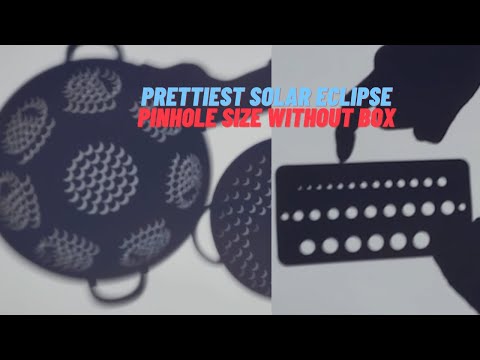
Prettiest Way to View Solar Eclipse through Colander Pinhole
Why build a cumbersome pinhole box when you can view a solar eclipse through a kitchen colander? Dr. David Zhang was the first to demonstrate this technique during the 2017 total solar eclipse, showing that each hole in a colander acts as a pinhole camera, projecting dozens of tiny eclipse images simultaneously onto any flat surface.
The Science of Pinhole Cameras
Three factors determine pinhole image quality: the size of the pinhole (smaller is sharper but dimmer), the roundness of the pinhole (more round produces better images), and the material thickness (thinner is better). A colander’s holes provide a reasonable balance of these factors, and the sun’s brightness means larger pinholes still produce good results.
Eclipse Viewing in Practice
Hold the colander in sunlight and look at its shadow on a flat surface like sidewalk or white paper. During a solar eclipse, each hole projects a tiny image of the partially eclipsed sun. The result is dozens of crescent shapes arranged in the colander’s hole pattern — a striking visual effect that is also informative.
Annular vs. Total Eclipse
The video was made during an annular eclipse, where the moon does not completely cover the sun, leaving a ring of fire effect. Dr. Zhang explains the difference between annular and total eclipses and how each appears through the pinhole projections.
For more science and travel content, see Dubrovnik, Croatia and preparing for Europe travel.
Stay curious and keep your eyes on the sky for the next eclipse. A kitchen colander is all you need.
A Colander Discovery During the 2017 Eclipse
I’m the Genius Asian. Welcome to the Genius family! We discovered something new on August 21st, 2017, when someone in our household realized that an everyday item — a colander — could double as an eclipse viewing tool. We demonstrated this technique during the solar eclipse at that time, and you can find the YouTube link in the description below.
Now, October 14th, 2023 is a date marked by another celestial event: an annular solar eclipse. An annular solar eclipse occurs when the moon appears slightly smaller than the sun, creating a ring-like effect as the moon covers the sun’s center.
Testing Pinhole Sizes
Today we’re attempting to determine the perfect pinhole size. Watch closely as we explore the holes in the last row of this template, ranging from one quarter inch to one sixteenth inch. We’ve discovered that other shapes and objects don’t perform as well, and larger holes need to be placed farther from the display for the best results.
There are three key factors to keep in mind for capturing the best images. First, the size of the pinhole plays a crucial role — a smaller hole yields sharper images, but it also dims the image, so striking the right balance between size and clarity is essential. Second, the pinhole must be perfectly round to ensure the best results. Third, the material used for the pinhole should be thin.
However, our goal here is different from scientific precision. We’re seeking a visual representation of the eclipse. Since the sun’s brilliance is ample and its edges are naturally sharp, we’ve opted for relatively larger pinhole sizes to capture the eclipse’s essence.
The Two Colanders
We’ve brought along two colanders for this experiment. The larger colander has holes of five thirty-seconds of an inch, while the smaller one features holes of nine sixty-fourths of an inch. Both have proven to be effective tools for witnessing the eclipse.
Watching the Eclipse Progress
In our local area, the partial eclipse was expected to begin at 8:03 a.m., reach its peak at 9:20 a.m., and conclude at 10:43 a.m. There are subtle patterns that emerge around half an hour before and after these times. As the moon shifts away from the center of the sun, you’ll notice a gradual shift in the moon’s shadow — it moves away from the center and towards one side.
Right now it’s 9:44 a.m. and the change is evident. You can see that the circle is no longer a circle; there is a small sliver out of it on one side. This is showing you the partial eclipse. You can also see that this is clear with the smaller pinholes, but does not show in the largest pinholes.
Fast-forwarding to 9:55 a.m., you can see that only a small black edge of the moon remains, covering only a small segment of the sun. The light that surrounds us, which had dimmed during the peak of the eclipse, has returned to a nearly normal level.
Closing Thoughts
Although opportunities are infrequent, eclipse viewing remains a special pastime for many — a reminder of the wonders that remain in the sky beyond us, the beauty and precision of the cosmos. We hope you’ve enjoyed this unique perspective on today’s annular solar eclipse and seen how simple tools you already have, like the colander, can be put to new uses.
This depends on the angle you hold the colander at. Hold it at some other angle and it might just show full circles [?]. Let’s see whether the moon has moved away.
Share this with people who you know need it. Leave your own genius tips in the comment section below. As always, don’t forget to like, subscribe, and explore the universe with us. Until next time, stay curious and keep looking up. I’m the Genius Asian — subscribe for more useful videos.