 Genius Asian
 Sagrada Familia, Barcelona, Spain
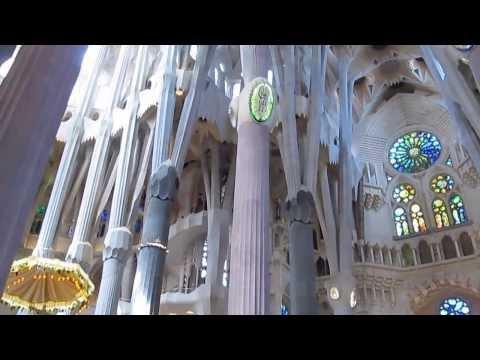
Sagrada Familia, Barcelona, Spain
The Sagrada Familia in Barcelona is unlike any church you will ever see. We visited during our Mediterranean cruise on the Carnival Breeze, and even after having already toured St. Peter’s Basilica in Rome and the Duomo in Florence earlier on the same trip, the Sagrada Familia left us genuinely speechless. It is probably impossible to find another church building anything like it anywhere else in the world. Designed by the visionary Catalan architect Antoni Gaudi, this massive Roman Catholic basilica has been under construction since 1882 — and the fact that it is still not finished is part of what makes it so extraordinary.
Key Takeaways
- The Sagrada Familia has been under construction since 1882 and was originally targeted for completion in 2026, the centennial of Gaudi’s death, though the timeline has shifted.
- Antoni Gaudi devoted the last 43 years of his life to the project, living on-site for his final years and leaving behind models and plans that guide construction to this day.
- The interior is unlike any other church — tree-like columns, extraordinary stained glass windows, and ceilings that seem to reach for infinity.
- The Nativity Facade is the most ornately decorated exterior, covered in intricate stone carvings depicting scenes from the birth of Christ.
- An elevator takes visitors to the tower tops, offering breathtaking views of Barcelona and a close-up look at Gaudi’s spire details.
- Book tickets online in advance — walk-up tickets are extremely limited and lines can be enormous.
A Brief History of the Sagrada Familia
Construction on the Sagrada Familia began in 1882 under architect Francisco de Paula del Villar. When Villar resigned after disagreements with the project’s religious patrons, a young Antoni Gaudi took over in 1883. He was just 31 years old, and the project would consume the rest of his life.
Gaudi radically redesigned the church, replacing the original neo-Gothic plans with his own revolutionary style — a fusion of Gothic structural principles, Art Nouveau organic forms, and innovations that were entirely his own invention. He studied natural forms obsessively, basing his column designs on the branching patterns of trees and his surfaces on the geometry of hyperboloids and paraboloids. The result is a building that looks simultaneously ancient and futuristic, organic and mathematical.
Gaudi knew he would not live to see the Sagrada Familia completed. “My client is not in a hurry,” he famously said, referring to God. He devoted his final years entirely to the church, even living in a small workshop on the construction site. When he died in 1926 after being struck by a tram, only about a quarter of the building was finished. He left behind detailed models and drawings that have guided subsequent generations of architects and builders.
Construction continued intermittently through the 20th century, surviving the Spanish Civil War (during which anarchists destroyed many of Gaudi’s original models and drawings) and long periods of insufficient funding. The pace accelerated dramatically in recent decades thanks to modern construction technology, computer-aided design, and a flood of revenue from the millions of tourists who visit each year.
The Exterior: Two Facades, Two Stories
The Sagrada Familia has three monumental facades, each telling a different part of the story of Christ. During our visit, two were largely complete.
The Nativity Facade
The Nativity Facade faces the northeast and was the first to be completed, largely under Gaudi’s direct supervision. It is staggeringly ornate. Every surface is covered with stone carvings — angels, animals, plants, human figures, and abstract forms all intertwined in a composition that seems to grow out of the building itself rather than being applied to it.
Looking up at the Nativity Facade, you cannot possibly take it all in with a single glance. We found ourselves bending over backward trying to fit the whole thing into a photograph, and it simply would not fit. The towers rise to such heights and the detail is so dense that you need to stand there for several minutes, scanning different sections, to begin appreciating the scope of what Gaudi created.
The Passion Facade
The Passion Facade on the southwest side is a stark contrast. Designed by sculptor Josep Maria Subirachs beginning in 1986, it features angular, austere figures that depict the suffering and crucifixion of Christ. Where the Nativity Facade overflows with life and detail, the Passion Facade is deliberately stripped down and emotionally raw. The contrast between the two facades is itself a statement about the range of human experience that the church encompasses.
The Interior: A Forest of Stone
If the exterior is astonishing, the interior is transcendent. Walking inside the Sagrada Familia is like stepping into a petrified forest designed by a mathematician. The columns that support the ceiling branch upward like trees, splitting into smaller and smaller supports as they rise. Gaudi designed this branching structure not just for aesthetic effect but as an engineering solution — the tree-like columns distribute the weight of the ceiling more efficiently than traditional Gothic flying buttresses.
The ceiling itself is mesmerizing. It rises to extraordinary heights, with geometric patterns formed by the intersecting branches of the columns creating a canopy effect. Looking straight up feels like gazing into a kaleidoscope made of stone.
The Stained Glass Windows
The stained glass windows are among the most beautiful we have ever seen in any church, anywhere. Gaudi designed the window placement and color schemes to create specific lighting effects throughout the day. The windows on the east-facing Nativity side use cool blues and greens, bathing the morning interior in aquatic light. The west-facing Passion side features warm reds, oranges, and yellows that glow with the afternoon sun. The effect changes hour by hour, and regular visitors say the church never looks the same way twice.
The Tower Elevator Experience
Visitors can take an elevator to the top of one of the towers for a breathtaking view of Barcelona stretching out to the Mediterranean Sea. The ride up is quick, but the descent is on foot — down a narrow, spiraling stone staircase that winds through the interior of the tower. The staircase itself is a work of art, a tight helix that Gaudi designed with mathematical precision. Through small windows in the tower walls, you get close-up views of the spire details, the construction cranes, and the city far below.
The tower experience is not for those with a fear of heights or claustrophobia. The staircase is narrow, and you will be sharing it with other visitors in a single-file line. But the views and the unique perspective on Gaudi’s architecture make it worthwhile.
The Museum
Below the main church, a museum displays original drawings, photographs, and plaster models from Gaudi’s workshop, including some that were painstakingly reconstructed after being damaged during the Civil War. The museum also explains the engineering and mathematical principles behind Gaudi’s designs, including his famous hanging chain models — inverted catenary arches that he used to determine the optimal shape for the building’s structure.
Seeing the models and drawings gives you a much deeper appreciation for the genius behind the building. Gaudi was not just an architect; he was a structural engineer, a naturalist, a geometer, and an artist all in one.
Practical Tips for Visiting
- Buy tickets online well in advance. The Sagrada Familia limits daily visitors, and time slots sell out, especially during summer. Booking two to three weeks ahead is recommended.
- Budget at least 90 minutes. You could easily spend two to three hours between the interior, the towers, and the museum.
- Visit in the morning for the best interior light. The east-facing stained glass windows are at their most spectacular in morning sunlight.
- Wear comfortable shoes. The tower descent involves hundreds of stone steps on a tight spiral staircase.
- Audio guides are worthwhile. The included audio guide provides context that transforms the visit from “wow, this is pretty” to “wow, this is revolutionary.”
How the Sagrada Familia Compares
Having visited St. Peter’s Basilica at the Vatican and the Florence Duomo on the same trip, we can say that each church excels in a different way. St. Peter’s overwhelms with its sheer scale and the weight of its history. The Duomo dazzles with Brunelleschi’s dome and Renaissance artistry. But the Sagrada Familia operates on a completely different plane — it is architecture as living organism, as mathematical proof, as spiritual experience. There is simply nothing else like it.
If you are planning a Mediterranean trip that includes Barcelona, make the Sagrada Familia your top priority. And if you are also visiting Italy, our guide to preparing for European travel covers the logistics of navigating multiple countries on a single trip.
Sources
- Original video on Genius Asian YouTube channel — full video demonstration and walkthrough.
- Barcelona Tourism — official visitor guide including Sagrada Familia tickets and accessibility information.