 Genius Asian
 Taiji (Tai Chi) Push Hands: Playing Guitar and Its Application
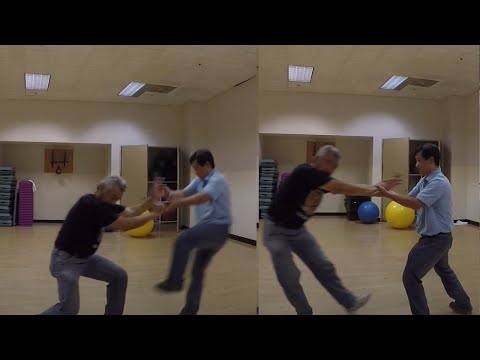
Taiji Push Hands: Playing Guitar and Its Application
Key Takeaways
- “Playing Guitar” (Shou Hui Pipa) is a specific Taiji form posture with direct push hands application
- The posture involves a precise hand position that resembles holding and strumming a guitar
- In push hands, this technique is used to control an opponent’s arm and redirect their energy
- Understanding the martial application behind each form position transforms practice from exercise to art
- Master Byron demonstrates both the form and its practical application with a partner
The Playing Guitar Posture
In Taiji form, the “Playing Guitar” posture (Shou Hui Pipa in Chinese) is one of the more distinctive positions. The practitioner stands with one foot forward, both hands raised as if holding an invisible guitar — one hand near the face (the “fretting” hand) and one extended forward (the “strumming” hand). The posture appears simple but contains sophisticated martial concepts.
The Push Hands Application
In partner practice, Playing Guitar becomes a technique for intercepting and controlling an incoming attack. The forward hand makes contact with the opponent’s wrist or forearm, while the rear hand controls their elbow. This two-point control allows you to redirect their force, lock their arm, or unbalance them.
The key principles at work include using two control points to manage one arm (leverage), maintaining a relaxed but connected structure so you can feel the opponent’s intentions, and directing their energy downward or to the side rather than meeting force with force.
Why Form Study Matters
Many Taiji practitioners learn the form as a health exercise without understanding the martial content. While the health benefits are real and valuable, understanding why each posture exists adds depth to practice. When you know that Playing Guitar is actually a technique for controlling an opponent’s arm, you practice the posture differently — with more intention, more precision, and more awareness of alignment and timing.
Training Progression
Begin by learning the solo form position with correct alignment and weight distribution. Then practice the application slowly with a cooperative partner. Gradually increase speed and resistance as both partners develop skill. The goal is not fighting but developing sensitivity, timing, and body mechanics.
The Journey of Internal Martial Arts Practice
Internal martial arts like Taiji, Bagua, and Xingyi require patience and long-term commitment to develop genuine skill. Unlike external martial arts where physical conditioning produces relatively quick results, internal arts demand that practitioners develop subtle body awareness, sensitivity to force, and the ability to move with integrated whole-body coordination. These qualities take years of consistent practice to cultivate.
The reward for this patience is a practice that continues to deepen throughout your lifetime. Many internal martial arts masters report that their skill continued to improve well into their sixties, seventies, and beyond. The art becomes richer with age rather than diminishing, because the principles of relaxation, sensitivity, and economy of movement become more refined over time.
Finding a supportive practice community is essential. Regular push hands practice with partners of varying skill levels provides the feedback needed for growth. Solo form practice develops body mechanics, but only partner work reveals whether those mechanics function under the pressure of real interaction. Seek out weekly practice groups, workshops, and seminars to supplement your regular training. For more content, check out our guide on how to do bathtub caulking or explore preparing for Europe travel.