 Genius Asian
 Can you carry a high power battery on a flight? What TSA/FAA size limit?
Can You Carry a High Power Battery on a Flight? TSA/FAA Size Limits
When buying a power bank for travel, understanding the TSA/FAA battery limits and the confusing measurement units is essential. In this video, Dr. David Zhang clarifies the terminology and demonstrates two different portable power banks suitable for air travel.
Understanding the Units
The most confusing aspect is that mAh (milliampere-hours) does not directly tell you the energy capacity. TSA/FAA limits are stated in Wh (watt-hours). The conversion requires knowing the voltage: Wh = mAh x Voltage / 1000. A 5000 mAh power bank at USB’s 5V equals only 25 Wh, well under the 100 Wh carry-on limit. Be careful: MAh (with capital M for mega) would be a billion times larger than mAh.
Two Power Banks Reviewed
A 10,000 mAh solar charger power bank (8 oz) with solar charging capability, compass, and flashlight. And a compact 5,000 mAh power bank (4 oz, 3.5 inches) with USB-C and Lightning output ports and percentage display. Both are well within TSA limits and practical for travel.
Solar Charging Features
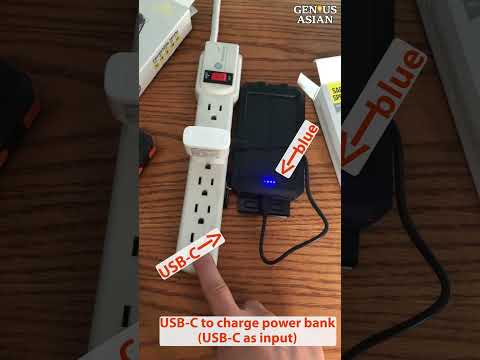
The solar panel charges the power bank from sunlight, indicated by a green LED. The USB-C port provides faster charging from a wall outlet, indicated by a blue LED. Three output ports (one USB-C and two USB-A) charge various devices.
For more travel preparation, see internet access tips when traveling to Europe and preparing for Europe travel.
Always check the Wh rating, not just the mAh rating, to ensure your power bank is airline compliant.
Why Battery Units Confuse Travelers
When buying a power bank, you may wonder whether you can carry a high-power battery on a flight. A couple of the measurements used for such batteries can be confusing.
When you see 5,000 mAh, the lowercase m means milli — milliampere-hour. MAh with a capital M means mega. Mega is actually a billion times larger than milli. The ampere-hour unit measures charge rate and does not represent battery energy capacity, which is watt-hours.
TSA/FAA Carry-On Limit Explained
At the TSA/FAA site, the size limit allowed on a flight is 100 watt-hours per battery. Watts are amperes multiplied by voltage — a better representation of battery capacity.
For example, 5,000 mAh at USB’s 5 volts is 5,000 times 5 equals 25,000 milliwatt-hours, which is only 25 watt-hours — well under the 100 watt-hour government carry-on baggage limit.
How to Charge the Solar Power Bank
There are two ways to charge this power bank. When the green light is lit, it is charging from the solar panel. The second way is through the USB-C port at the center: when connected to a USB phone charger, the LED turns blue.
Once charged, the power bank can charge phones or tablets through one of three output ports — the center USB-C port and two USB-A ports on the left and right. The same USB-C port used for input is also used as an output port.
Outdoor Features of the Solar Model
In addition to solar charging, two other features are useful for outdoor use. First, there is a built-in compass. Second, pressing the power button for four seconds turns on the flashlight. The solar model comes in two color options: one fully black, and one labeled orange that has the main area in black with two orange stripes on each side. It has a capacity of 10,000 mAh and weighs 8 ounces.
The Compact 5,000 mAh Option
The lighter 4-ounce power bank without solar has half the capacity — 5,000 mAh — and is only 3.5 inches long. It includes an input USB-C port, a display showing the remaining percentage charge, and two output ports: one for iPhone [Lightning?] and one USB-C. It also has a flashlight. Both products are linked to the video.