 Genius Asian
 Part2, Tai Chi Push Hands Deliver Power By Shifting Weight
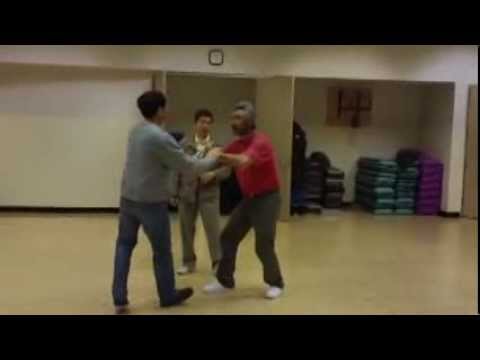
Tai Chi Push Hands Part 2: Delivering Power by Shifting Weight and Lifting the Heel
Key Takeaways
- Power in Tai Chi push hands comes from shifting your body weight, not from pushing with your arms
- Different students need different adjustments — there is no one-size-fits-all correction
- Master Byron Zhang teaches by closing his eyes and feeling the touch, emphasizing feel over visual appearance
- The adjustments being made are extremely subtle — measured in millimeters rather than inches
- Lifting the heel is a key mechanism for weight transfer and power delivery
Feel Over Appearance
One of the most striking aspects of Master Byron Zhang’s teaching method is that he closes his eyes while making adjustments to students. This is not a theatrical gesture — it serves a real purpose. By eliminating visual input, the Master relies entirely on tactile feedback to sense what the student is doing internally.
This reinforces a core principle of Water Taiji: the practice is about feeling, not looking. You cannot see whether someone’s weight is properly rooted or whether their energy is connected from feet to hands. You can only feel it through touch. By teaching with eyes closed, Master Byron demonstrates that the essential information is in the physical contact, not in the external appearance of the movement.
Different Students, Different Adjustments
This video shows Master Byron working with multiple students, and the adjustments he makes are different for each person. This is an important point. In push hands training, every practitioner has different habits, different body structures, and different areas of tension or weakness. A correction that is right for one student might be irrelevant or even counterproductive for another.
The common thread is the principle: power comes from weight shifting, specifically from the mechanism of lifting and settling the heel. But how each student needs to implement that principle depends on their individual body mechanics and current level of understanding.
The Heel-Lifting Mechanism
The core technique demonstrated in this lesson is the use of heel lifting as a power delivery mechanism. Here is how it works:
The Concept
When you shift your weight forward in push hands, the traditional approach is to push with the arms. But that only uses the relatively weak muscles of the arms and shoulders. The Water Taiji approach is different:
- Root into the rear foot — let your weight settle deeply into the back leg
- Begin shifting forward by lifting the rear heel slightly — this starts the weight transfer
- The body weight itself becomes the power — as your mass shifts forward through the legs and hips, that momentum transfers through your connected structure into the partner
- The arms remain relaxed — they are the conduit, not the engine
Why This Is More Powerful
The difference in power between arm pushing and weight-shift pushing is dramatic. Your arms can generate perhaps 20-40 pounds of force on their own. But when your entire body weight (150-200 pounds or more) shifts as a connected unit, that force is transmitted through the point of contact. The partner feels an irresistible wave rather than a muscular push.
The Subtlety
What makes this difficult to learn is the subtlety involved. The transcript mentions adjustments of “a few millimeters.” The heel lift does not need to be large — in fact, it should barely be visible. The power comes from the weight transfer, not from the size of the movement. A micro-shift done with proper connection is far more effective than a large movement done with muscular force.
Practicing This at Home
Even without a partner, you can work on the weight-shifting mechanism:
- Stand in a basic push hands stance with one foot forward and one back
- Let your weight settle into the rear foot until you feel grounded
- Slowly begin shifting forward by slightly lifting the rear heel
- Feel the weight transfer through your body from back to front
- Keep your arms extended but relaxed — they should not be doing any work
- Reverse the process: settle the rear heel, shift weight back
The key is to feel the continuous connection from rear foot through your body to your front hand. If there is a break in that chain — tension in the shoulders, locked hips, rigid knees — the power does not transmit cleanly.
Connecting to the Broader Practice
This lesson builds on the foundations established in the push hands basic training series. The weight-shifting and heel-lifting principles demonstrated here apply not only to push hands but to every movement in the Tai Chi form.
For a deeper exploration of the underlying physics and energy mechanics, see our guide on Taiji physics and energy move fundamentals. The principles are the same whether you are practicing solo form, push hands, or martial applications.