 Genius Asian
 Taiji (taichi) physics and energy move fundamental
Taiji Physics and Energy Move Fundamentals: Understanding the Circle of Power
Key Takeaways
- Every movement in Taiji should be one unified whole-body move, not a collection of arm and leg movements
- The energy path forms a circle: from your mind down to your feet, through the ground, and back up through your partner
- If you only use hand energy without involving your body, you cannot effectively push or control your partner
- The practice involves an exaggerated step-by-step method (steps 1 through 5) to isolate and feel each part of the movement chain
- Students practice alongside Master Byron, and their mistakes provide valuable learning opportunities
The One-Unit Move
The central concept in this lesson is deceptively simple: every movement in Taiji should be one unit. Your entire body moves as a single connected system. But what does that actually mean in practice?
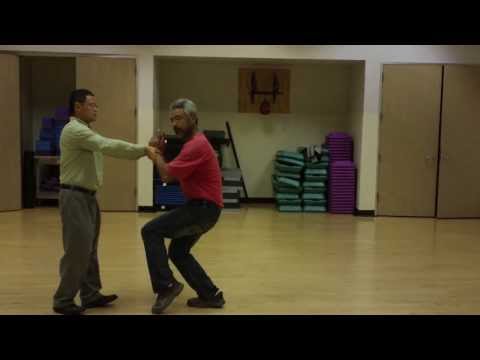
Master Byron demonstrates this through push hands. When he tries to lift or push his partner using only hand and arm energy — without involving the rest of his body — it does not work. The partner can easily resist because the force is coming from a small, weak source (the arms).
But when Byron directs his energy (his mind, really) through a complete circuit — down to his feet, into the ground, and then up through his structure to the contact point — the same movement becomes irresistible. The partner feels the entire body weight behind the touch.
The Circle of Energy
The energy path that Master Byron describes forms a circle, and understanding this circle is fundamental to all Taiji practice:
- Start with your mind: Direct your attention and intent downward
- Through your body to your feet: Let your awareness and energy settle through your legs into the ground
- Into the ground: Feel the ground supporting and returning your energy (like bouncing a ball)
- Up through your structure: The returning energy travels up through your legs, spine, and arms
- Through the contact point: Into your partner’s back and beyond
The key insight is that this circle goes “bigger” with practice. Instead of a small loop from hand to partner, the circle extends down through the ground and back up. The bigger the circle, the more power is available, because you are connecting to the earth rather than relying on muscular effort.
The Exaggerated Practice Method
To help students feel each stage of this energy circuit, Master Byron teaches an exaggerated practice method. The full movement is broken down into discrete steps (numbered 1 through 5), and each step is performed as a large, obvious movement before the whole sequence is combined and refined.
This is like learning to type: you start by deliberately pressing each key with exaggerated finger movements, and gradually the movements shrink until they are fast, efficient, and automatic. Similarly, the exaggerated Taiji practice lets you feel and verify each part of the energy circuit. Over time, the steps merge into a single fluid movement.
Why Exaggeration Helps
Many students struggle with Taiji because the correct movements are so subtle that they cannot feel what is happening. By making the steps large and obvious:
- You can verify that your weight is actually transferring (not just imagining it)
- You can feel the ground connection physically
- You can identify breaks in the chain where tension or misalignment interrupts the energy flow
- Your practice partner can feel the difference and provide feedback
Student Practice Footage
A significant portion of this video shows students practicing under Master Byron’s guidance. This is intentionally included because watching other students — especially their mistakes and corrections — provides insights that watching a master cannot.
When you see a student struggle to generate power through weight shifting, and then see the correction that unlocks it, you gain a deeper understanding of the principle than you would from watching flawless execution alone. Look for:
- Students who push with their arms and get no result
- The moment when they connect to their feet and the partner suddenly moves
- The subtle body adjustments Master Byron makes through touch
- How different students express the same principle differently based on their body type
Applying These Principles to Solo Form
Although this lesson uses push hands as the teaching vehicle, the physics and energy principles apply to every movement in the Taiji solo form. When you practice the form:
- Every hand movement should originate from your feet
- Every turn should be powered by weight shifting, not arm swinging
- Every transition should maintain the circle of energy from ground through body to hands
- If you can push with the same connected power during form practice that you can during push hands, your form is correct
Getting Started
For students new to these concepts:
- Start with the push hands basic training series to learn the external patterns
- Practice the weight shifting and heel lifting technique to develop the mechanical foundation
- Return to this video to understand the complete energy circuit
- Apply these principles during your Yang Style Water Taiji form practice
The path is progressive: learn the outer shape first, then fill it with correct internal mechanics, and finally let the mechanics become natural and invisible.