 Genius Asian
 Part3, Tai Chi Push Hands Deliver Power By Shifting Weight
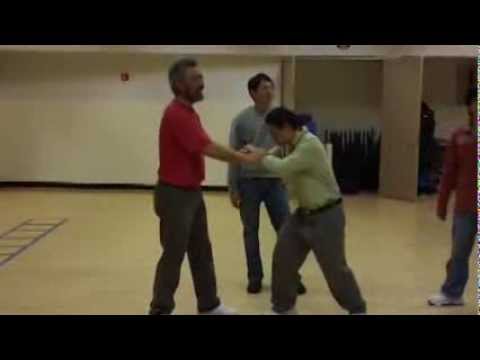
Tai Chi Push Hands: Delivering Power by Shifting Weight Part 3
Key Takeaways
- Part 3 continues exploring weight-shift power delivery with individualized corrections for each student
- Master Byron Zhang teaches with his eyes closed, relying entirely on tactile feedback to assess students
- At higher skill levels, the exaggerated training movements become internalized and nearly invisible
- Different students need different adjustments — there is no universal correction for weight-shift issues
- The progression from visible technique to invisible feeling is a central theme of Water Tai Chi development
What This Video Shows
In this concluding part of the weight-shifting power delivery series, Master Byron Zhang addresses a question that many students wonder about: do masters at higher levels use the same exaggerated movements that are taught in training? The answer reveals an important principle about how Tai Chi skills evolve over time.
The video continues the hands-on correction format from Parts 1 and 2, with Master Byron working individually with students to refine their weight-shifting mechanics. The adjustments he makes are measured in millimeters, not inches — a testament to how subtle this work becomes at more advanced levels.
Eyes Closed Teaching
One of the most distinctive aspects of Master Byron’s teaching method is that he closes his eyes while making corrections. This is not showmanship. By eliminating visual input, he forces himself to rely on the same tactile feedback that push hands practitioners need to develop.
This teaching method makes a powerful point: if the master can assess your mechanics entirely through touch, then the information transmitted through physical contact is sufficient for push hands. You do not need to see your partner to understand what they are doing. You need to feel them.
From Exaggerated to Invisible
Master Byron addresses the natural question: why are training movements so exaggerated when real application looks nothing like that? The answer is developmental. At the beginning, you need large, clear movements to establish the correct pathways in your body. The heel lift, the weight shift, the connection from ground to hand — all of these need to be practiced in an obvious, measurable way.
As skill develops, the movements shrink. What was once a visible heel lift becomes a micro-movement. What was once a deliberate weight shift becomes an automatic adjustment. The principle remains identical; only the scale changes.
This is why Master Byron says that at higher levels, the explicit training form becomes less important. The practitioner has internalized the principles so deeply that they express automatically, adapted to each unique situation.
Completing the Power Delivery Series
With this third installment, you have a complete picture of how weight-shift power works in Water Tai Chi push hands. The progression from Part 1 through Part 3 mirrors the learning journey itself: from understanding the concept, to practicing the mechanics, to refining the subtleties.
Building a Sustainable Practice
The journey of Tai Chi development is measured in months and years, not days and weeks. Here are principles that will serve you well regardless of where you are in your practice:
Consistency Over Intensity: Ten minutes of daily practice produces better results than a three-hour session once a week. Your nervous system needs regular input to build the pathways that make push hands and form work effective. Treat your practice like brushing your teeth — something you simply do every day, not something you negotiate with yourself about.
Quality Over Quantity: Slow, mindful repetitions with full attention are worth more than hundreds of distracted repetitions. When you practice, be present. Feel each weight shift, notice each point of tension, and consciously release what does not serve the movement.
Patience With Plateaus: Everyone hits periods where improvement seems to stall. These plateaus are not signs of failure — they are periods of integration where your nervous system is consolidating what it has learned. Continue practicing through plateaus and breakthroughs will come.
Community and Sharing: Tai Chi was traditionally learned in community, and that model remains the most effective. Practice with different partners, discuss your experiences, and share what you discover. The more perspectives you encounter, the richer your understanding becomes.
For the foundational work that supports this power delivery, revisit the basic training Part 1. For the theoretical framework, see Taiji physics and energy fundamentals.