 Genius Asian
 Tai Ji (Tai Chi) Merge Three Gravity Centers Into One
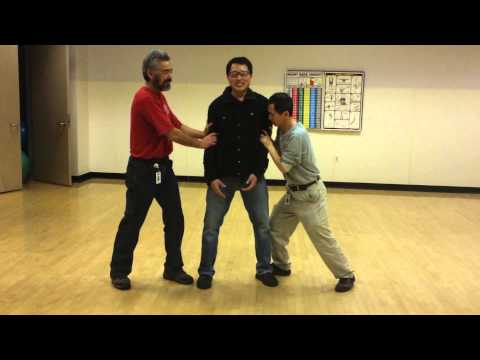
Tai Ji (Tai Chi) Merge Three Gravity Centers Into One
Key Takeaways
- The human body has three primary gravity centers that must be unified for effective Tai Chi practice
- Master Byron Zhang teaches how to connect and merge these centers into a single coordinated unit
- When the three centers operate independently, movement is fragmented and power generation is inefficient
- Merging the centers creates whole-body unity, the foundation of internal martial arts power
- This concept is one of the more advanced training principles in Tai Chi push hands and form practice
The Three Gravity Centers
In Tai Chi theory as taught by Master Byron Zhang, the human body can be understood as having three primary gravity centers that each govern a portion of the body’s mass:
The Upper Center: Located in the chest and shoulder area, governing the arms and upper torso. This center tends to be the most active because we use our arms for most daily tasks, making it the most developed but also the most prone to generating tension.
The Middle Center: Located at the dantian (lower abdomen), governing the core and hip area. In Tai Chi, this is considered the most important center — it is where qi gathers and from which all movement ideally originates.
The Lower Center: Located in the legs and feet, governing the base of support and connection to the ground. This center provides root and stability, and is the source of all power generation in Tai Chi through ground reaction force.
Why They Need to Merge
Most people move with these three centers operating somewhat independently. The arms do their own thing, the torso follows along, and the legs provide transportation. In daily life, this works adequately. But in Tai Chi — especially in push hands — this fragmentation is a critical weakness.
When a partner pushes your chest, the force impacts your upper center. If your three centers are not connected, the push displaces your upper body while your lower body remains behind, creating a shearing effect that makes you easy to uproot. If the centers are merged into one, the same push is distributed through your entire body and directed to the ground through your legs, making you much harder to move.
Similarly, when you push a partner, fragmented centers mean you are pushing primarily with your arms (using perhaps 10-15 percent of your body weight). Merged centers mean your entire body mass stands behind the push, multiplying your effective force many times over without requiring muscular effort.
How to Practice Merging
Master Byron Zhang demonstrates several approaches to developing center unity:
Standing Practice (Zhan Zhuang): Simply standing in a basic Tai Chi posture and directing attention to feeling all three centers simultaneously. This develops awareness of the centers as a first step toward connecting them.
Slow Weight Shifting: Shift weight from one foot to the other while maintaining awareness of how the three centers move together. They should move as a coordinated unit, not sequentially.
Partner Testing: Have a partner place their hands on your chest and push gently. Feel whether the force travels through your connected structure to the ground, or whether it gets stuck at one of the center boundaries.
Form Practice with Center Awareness: Perform your Tai Chi form while focusing on keeping all three centers moving as one unit throughout every transition and posture.
The Connection to Power Generation
The practical payoff of merging the three gravity centers is the ability to generate and receive force with your entire body mass rather than just a portion of it. This is the physical foundation of the internal martial arts concept of whole-body power (zheng ti jin). It explains how smaller Tai Chi practitioners can generate forces that seem disproportionate to their size, and why muscular practitioners are sometimes easily uprooted by physically smaller but better-connected ones.
For more on gravity center training, see gravity center in form training and push hands alignment.