 Genius Asian
 Taiji ( Taiji) Circular Energy Expansion & Contraction In Push Hands
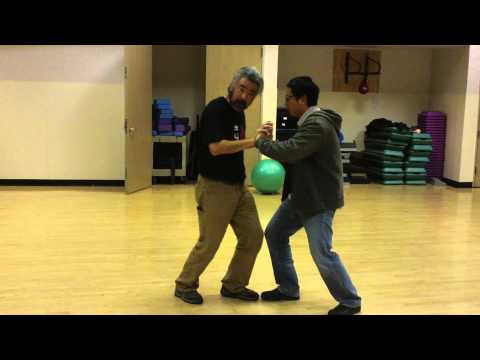
Taiji ( Taiji) Circular Energy Expansion & Contraction In Push Hands
Key Takeaways
- Circular energy is a fundamental concept in Tai Chi push hands that distinguishes it from linear fighting arts
- Expansion and contraction work together as complementary phases of the same circular movement
- Master Byron Zhang demonstrates how to practice circular energy patterns with a partner
- The circle allows continuous flow — there is no start or stop, only transitions between expansion and contraction
- Understanding circular energy transforms push hands from a contest of strength into a dance of sensitivity
The Principle of Circular Energy
In many martial arts, force is applied in straight lines — a punch travels directly from the fist to the target, a kick sweeps in an arc. Tai Chi operates differently. All force in Tai Chi moves along circular or spiral paths, and understanding this principle is essential for effective push hands practice.
Circular energy means that you are never simply pushing forward or pulling back. Instead, every movement follows a curved trajectory that seamlessly connects offense and defense. When you push, the energy arcs forward and then curves back toward you, preparing for the next phase. When you yield, the energy curves inward and then redirects outward, setting up the counterattack.
Expansion and Contraction
Master Byron Zhang explains that circular energy has two complementary phases:
Expansion (Zhang): The outward phase where energy extends away from your center. In push hands, this corresponds to issuing force — pushing, pressing, or striking. During expansion, your body opens: the chest widens slightly, the arms extend, and the energy moves from your center toward the periphery and into your partner.
Contraction (Shou): The inward phase where energy draws back toward your center. This corresponds to absorbing, yielding, and gathering. During contraction, your body closes: the chest rounds slightly, the arms draw back, and you collect incoming energy and redirect it through your structure to the ground.
The critical insight is that these two phases are not separate actions but continuous aspects of the same circular motion. There is no pause between expansion and contraction — one flows directly into the other, like the continuous rotation of a wheel.
Practicing Circular Energy
With a Partner
Stand facing your partner with forearms in light contact. Begin a slow, synchronized circular motion where both practitioners move their arms in the same circular path. One person’s expansion corresponds to the other’s contraction. As the circle continues, gradually increase the amount of energy being exchanged. The circle should remain smooth and continuous, with neither partner stopping or jerking at any point.
Common Mistakes
Linear thinking: Pushing straight forward and pulling straight back instead of following a curved path. This creates dead spots where your energy stops and your partner can exploit the gap.
Uneven rhythm: Speeding up during the expansion (aggressive) phase and slowing down during the contraction (yielding) phase. The circle should move at constant speed throughout.
Tension in the shoulders: This locks the arms to the torso and prevents the smooth rotation that circular energy requires. Keep the shoulders dropped and relaxed.
Disconnection from the center: The circular motion should originate from the waist and dantian, not from the arms. If your arms are making circles while your torso stays static, you are not practicing circular energy — you are waving your arms.
Why Circular Energy Matters
The practical advantage of circular energy in push hands is that it eliminates the vulnerable transition points that exist in linear movement. In a linear push, there is a moment when you have fully extended and must reverse direction — a moment of weakness where a skilled partner can exploit your overextension. Circular movement has no such endpoint. The push curves naturally into the yield, and the yield curves naturally into the next push, creating a continuous and unbroken flow.
For more on push hands principles, see how to practice push and receive push and breathing in Taiji push hands.