 Genius Asian
 8-Energy 5 Steps 13 Postures, Part 2, 八門五步 十三勢
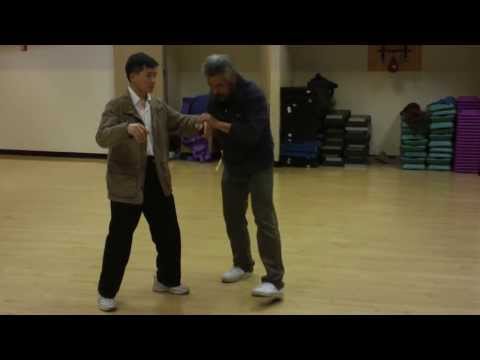
8 Energies, 5 Steps, 13 Postures Part 2: Mind Work and the One Feeling
Key Takeaways
- Part 2 moves beyond the physical framework into the mental and energetic aspects of the 13 postures
- Water Tai Chi has no fixed forms — the “one feeling” unifies all movements
- The mind (yi) directs the energy, not muscular intention
- Other Tai Chi styles may interpret these concepts differently, and that diversity is valuable
- The progression from physical technique to mind-directed movement represents advancing skill
What This Video Shows
After establishing the framework of 8 energies, 5 steps, and 13 postures in Part 1, Master Byron Zhang now delves into what makes Water Tai Chi’s interpretation unique: the concept that there are no fixed forms, and that all movement should be unified by a single feeling directed by the mind.
This is where Water Tai Chi diverges most sharply from many other styles. While most Tai Chi schools teach specific forms with defined positions, Water Tai Chi treats the form as an expression of internal principles rather than a sequence to memorize.
No Forms in Water Tai Chi
The statement “there are no forms in Water Tai Chi” can be confusing if taken literally. Students still learn and practice recognizable Tai Chi movements. What Master Byron means is that the forms are not the goal — they are the vehicle. The goal is to develop the internal principles that the forms express.
When a practitioner reaches a sufficiently advanced level, the specific external form becomes less important than the internal quality of the movement. Two practitioners might look different on the outside while both expressing the same internal principle correctly.
The “One Feeling”
The concept of “one feeling” is central to this lesson. Rather than thinking about 8 separate energies and 5 separate steps, the advanced practitioner experiences them as one unified sensation. The mind directs this sensation, and the body responds as an integrated whole.
This unification is what makes advanced push hands practitioners seem effortless. They are not cycling through a mental checklist of techniques. They are responding from a single, unified state of awareness that automatically selects the appropriate energy and direction.
Mind Work (Yi)
The role of the mind (yi) in Tai Chi is often discussed but rarely explained clearly. Master Byron offers practical insight: the mind leads, the energy follows, and the body expresses. This is the opposite of how most people move, where the muscles lead and the mind follows.
In practical terms, this means:
- Before your body moves, your mind has already moved
- You do not think about which arm to raise; you think about the direction and purpose
- The body reorganizes itself to serve the mind’s intention
- With practice, this mental direction becomes instantaneous
Building a Sustainable Practice
The journey of Tai Chi development is measured in months and years, not days and weeks. Here are principles that will serve you well regardless of where you are in your practice:
Consistency Over Intensity: Ten minutes of daily practice produces better results than a three-hour session once a week. Your nervous system needs regular input to build the pathways that make push hands and form work effective. Treat your practice like brushing your teeth — something you simply do every day, not something you negotiate with yourself about.
Quality Over Quantity: Slow, mindful repetitions with full attention are worth more than hundreds of distracted repetitions. When you practice, be present. Feel each weight shift, notice each point of tension, and consciously release what does not serve the movement.
Patience With Plateaus: Everyone hits periods where improvement seems to stall. These plateaus are not signs of failure — they are periods of integration where your nervous system is consolidating what it has learned. Continue practicing through plateaus and breakthroughs will come.
Community and Sharing: Tai Chi was traditionally learned in community, and that model remains the most effective. Practice with different partners, discuss your experiences, and share what you discover. The more perspectives you encounter, the richer your understanding becomes.
For the conclusion of this series, see Part 3. For the foundational physical practice, revisit the basic training Part 1. For the complete version combining all three parts, see 8 Energies 5 Steps 13 Postures All.