 Genius Asian
 Tai Chi Push Hands Deliver Power By Shifting Weight, Part 1
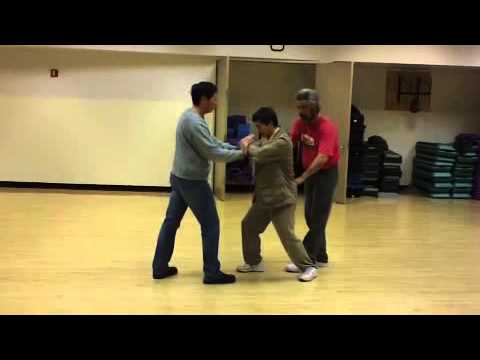
Tai Chi Push Hands: Delivering Power by Shifting Weight Part 1
Key Takeaways
- This lesson introduces the core mechanism of power delivery in Water Tai Chi: weight shifting and heel lifting
- Power in push hands should come from your body weight, not from muscular effort in the arms
- Master Byron Zhang demonstrates the technique and corrects students’ execution
- The heel-lifting mechanism begins the weight transfer that generates real force
- Each movement can be practiced independently, making this accessible to practitioners at any level
What This Video Shows
Master Byron Zhang introduces one of the most important principles in Water Tai Chi push hands: how to deliver power through weight shifting rather than muscular pushing. This is part one of a three-part series that breaks down the mechanics of effective force generation.
The central idea is straightforward but difficult to execute: your body weight is far more powerful than your arm muscles. If you can learn to transfer your entire body weight through the point of contact with your partner, you will generate irresistible force without any muscular strain.
The Weight-Shifting Principle
Most beginners push with their arms. This is natural but ineffective. The arms are relatively weak compared to the mass of the entire body. When you push with your arms, your partner feels localized pressure that is easy to deflect.
When you push with your body weight, the experience is completely different. Your partner feels a wave of force that has no single point of origin. It is harder to deflect because the force is distributed and backed by your entire mass.
The key mechanism is heel lifting:
- Root your weight into the rear foot
- Begin shifting forward by gently lifting the rear heel
- Allow the weight to transfer through your connected structure
- Keep the arms soft — they transmit force but do not generate it
- The partner receives the full impact of your body weight through the contact point
Student Practice and Corrections
Master Byron works with students to help them feel the difference between arm pushing and weight-shift pushing. The corrections are highly individual — each student needs different adjustments based on their body habits and tensions.
Common corrections include:
- Relaxing the shoulders, which tend to tense up when trying to generate power
- Keeping the rear heel lift small and controlled rather than dramatic
- Maintaining a connected structure from foot to hand
- Allowing the weight to do the work instead of adding muscular effort
Building This Skill
Weight-shift power delivery is a skill that develops gradually through consistent practice. Start by practicing against a wall:
- Stand facing a wall in push hands stance
- Place your hands flat on the wall at chest height
- Practice shifting your weight into the wall by lifting the rear heel
- Feel the difference between pushing with your arms and pushing with your weight
- The wall should feel the impact of your mass, not just your hand pressure
For the continuation of this training, see Part 2 and Part 3. For the foundational Peng Lu Ji An training, revisit the basic training series.